


Page 44 - MWJC_JanFeb2019_eMag
P. 44
TechnicalFeature  技术特写


                                                                离也会由于PCB加工带来一些不确定性。还有,每个材料上的
                                                                微小变化如Dk值的微小变化,也可能导致变化。考虑到这些
                                                                不确定性,在39 GHz相位的可重复性在±1.2度是合理的。
                                                                    虽然Dk的变化不是测量评估中的一个因素,但需注意到
                                                                RO4730G3线路板材料的Dk容限在±0.05以内。在更高的频率
                                                                下,即使轻微的Dk变化有时也是很明显的:例如,在39 GHz
                                                                时,0.05的Dk偏移将导致大约为15.3度的相位角变化。对于
                                                                ±0.05的公差或0.10的总Dk偏移,39GHz处的相位角可能会有
                                                                多达30.6度的变化。当考虑表1中的相位角变化时,这个数值
                                                                是很好的参考。但由于这些测试电路都来自于同一块大板,因
                                                                此可以预期由于Dk变化导致的相位角变化非常小。
                                                                    表2显示了使用RO4730G3线路板加工的具有更粗糙的通
                                                                孔孔壁的电路的相位差异平均值、标准差和相位变化范围。通
                                                                过比较表1和表2,可以看出RO3003G2和RO4730G3线路板之
                                                                间的统计差异并不明显。如前所述,在这些试验过程中,为了
                                                                尽量减少材料带来的变化,电路板1和2都来自同一块大板。对
                                                                于相位角的比较结果以及出现的任何差异主要是来自电路加工
                                                                的影响。当对结果的分析仅限于同一张电路板时,相位角由于
                                                                材料带来的影响是最小的。每张大板上电路的S21的展开相位
                                                                角上都有一定的变化,但考虑到在两种不同材料上制作的电路
                                                                时,可以看到这种变化并不显著。
                                                                    显然,通过观测显微照片,不同材料上的通孔的孔壁呈现
                                                                出很大的不同。例如,图2显示了在20mil厚的RO3003G2线路
                                                                板上加工的电路P1C1的通孔,它具有非常光滑的通孔孔壁。
                                                                而基于20.7mil厚的RO4730G3线路板材料的电路P2C6(见图
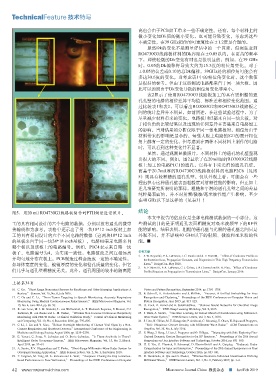
                                                                5)则具有较粗糙的通孔孔壁。仅从外观上看,可能会有一些
                                                                理由担心这种通孔壁表面粗糙度对射频性能的影响。但正如上
                                                                述几项研究所表明的那样,粗糙和平滑的通孔孔壁之间的差异
                                                                纯粹是表面的,并不对射频/微波/毫米波性能产生影响,至少
                                                                在40 GHz以下是这样的(见表3)!

             图5:用20 mil RO4730G3线路板制作的PTH侧壁近景照片。                结论
                                                                    本文中报告的信息仅是全部电路测试数据的一小部分。这
             工的具有相同设计的六个电路的数据,分别以没有通孔的微带                        些测试的目的是证明通孔表面粗糙度对毫米波频率下的RF性
             传输线作为参考。表格中还示出了另一块18*12 inch板材上加                   能的影响。结果表明,粗糙的通孔壁与光滑的通孔壁之间只是
             工的具有相同设计的六个不同电路的数据(这两块18*12 inch                   外观不同,并不影响40 GHz以下的射频、微波和毫米波的性
             的基板来自于同一块24*18 inch基板)。电路ID表示电路来自                  能。■
             哪个板以及该板上的电路编号。例如,P1C4表示来自第一块
             板子、电路编号为4。为实现一致性,电路彼此之间互相远离                        参考文献
                                                                1.  J. W. Reynolds, P. A. LaFrance, J. C. Rautio and A. F. Horn III, “Effect of Conductor Profile on
             并均匀地分布在板上。PCB制造过程会造成一定的不确定性,                          the Insertion Loss, Propagation Constant, and Dispersion in Thin High Frequency Transmission
                                                                   Lines,”DesignCon, May 2010.
             如导体宽度的变化、镀铜厚度的变化和钻孔质量的变化,但它                        2.  A. F. Horn III, P. A. LaFrance, C. J. Caisse, J. P. Coonrod and B. B. Fitts, “Effect of Conductor
             们几乎与通孔壁粗糙度无关。此外,通孔周围的较小的隔离距                           Profile Structure on Propagation in Transmission Lines,” DesignCon, January 2016.

             上接第34页
             16.  C. Gu, “Short-Range Noncontact Sensors for Healthcare and Other Emerging Applications: A   Vision and Pattern Recognition, September 2014, pp. 1701–1708.
               Review,” Sensors, Vol. 16, No. 8, July 2016.     23.  F. Schroff, D. Kalenichenko and J. Philbin, “Facenet: A Unified Embedding for Face
             17.  C. Gu and C. Li, “From Tumor Targeting to Speech Monitoring: Accurate Respiratory   Recognition and Clustering,” Proceedings of the IEEE Conference on Computer Vision and
               Monitoring Using Medical Continuouswave Radar Sensors,” IEEE Microwave Magazine, Vol.   Pattern Recognition, June 2015, pp. 815–823.
               15, No. 4, June 2014, pp. 66–76.                 24.  G. Koch, R. Zemel and R. Salakhutdinov, “Siamese Neural Networks for One-Shot Image
             18.  K. van Loon, M. J. M. Breteler, L. van Wolfwinkel, A. T. Rheineck Leyssius, S. Kossen, C.J.   Recognition,” ICML Deep Learning Workshop, Vol. 2, 2015.
               Kalkman, B. van Zaane and L. M. Peelen, “Wireless Non-Invasive Continuous Respiratory   25.  J. Weiß, A. Santra, “One-Shot Learning for Robust Material Classification using Millimeter-
               Monitoring with FMCW Radar: a Clinical Validation Study,” Journal of Clinical Monitoring   Wave Radar System,” IEEE Sensors Letters, Vol. 2, No. 4, 2018.
               and Computing, Vol. 30, No. 6, December 2016, pp. 797–805.  26.  J. Lien, N. Gillian, M. E. Karagozler, P. Amihood, C. Schwesig, E. Olson, H. Raja and I.Poupyrev,
             19.  C. Li, J. Lin and Y. Xiao, “Robust Overnight Monitoring of Human Vital Signs by a Non-  “Soli: Ubiquitous Gesture Sensing with Millimeter Wave Radar,” ACM Transactions on
               Contact Respiration and Heartbeat Detector,”International Conference of the Engineering in   Graphics, Vol. 35, No. 4, July 2016.
               Medicine and Biology Society, August 2006, pp. 2235–2238.  27.  S. Wang, J. Song, J. Lien, I. Poupyrev and O. Hilliges, “Interacting with Soli: Exploring Fine-
             20.  E. Yavari, C. Song, V. Lubecke and O. Boric-Lubecke, “Is There Anybody in There?:   Grained Dynamic Gesture Recognition in the RF Spectrum,” Proceedings of the 29th Annual
               Intelligent Radar Occupancy Sensors,” IEEE Microwave Magazine, Vol. 15, No. 2, March-  Symposium on User Interface Software and Technology, October 2016, pp. 851–860.
               April 2014, pp. 57–64.                           28.  H. S. Yeo, G. Flamich, P. Schrempf, D. Harris-Birtill and A. Quigley, “Radarcat: Radar
             21.  A. Santra, R.V. Ulaganathan and T. Finke, “Short-Range Millimetric-Wave Radar System for   Categorization for Input and Interaction,” Proceedings of the 29th Annual Symposium on User
               Occupancy Sensing Application,” IEEE Sensors Letters, Vol. 2, No. 3, September 2018.  Interface Software and Technology, October 2016, pp. 833–841.
             22.  Y. Taigman, M. Yang, M. A. Ranzato and L. Wolf, “Deepface: Closing the Gap to Human-  29.  K. Diederichs, A. Qiu and G. Shaker, “Wireless Biometric Individual Identification Utilizing
               Level Performance in Face Verification,” Proceedings of the IEEE Conference on Computer   Millimeter Waves,” IEEE Sensors Letters, Vol. 1, No. 1, February 2017, pp. 1–4.
             42 www.mwjournalchina.com                                      Microwave Journal China  微波杂志  Jan/Feb 2019

